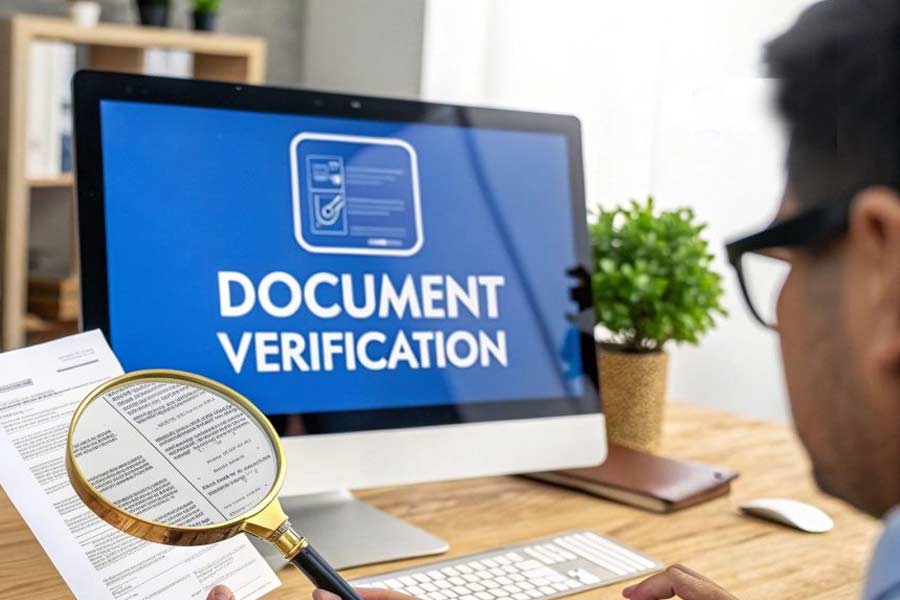
When it comes to real estate transactions in New Jersey, accuracy isn’t optional — it’s everything. Whether you’re handling a title search in Bergen County, verifying liens in Essex County, or tracing deed history in Ocean County, the quality of your public records search New Jersey can determine whether a deal closes cleanly or collapses at the last minute.
Today, many professionals face a choice between two approaches: the speed and scale of automated database searches or the precision and reliability of human-verified record retrieval. Both have their place, but understanding their differences — and limitations — is critical for anyone serious about due diligence in New Jersey real estate.
What Is an Automated Public Records Search?
Automated public records searches rely on aggregated databases populated by third-party data vendors. These systems pull property records, lien filings, tax assessments, and court judgments from various county and state sources, compiling them into a searchable digital format.
On the surface, it sounds ideal: fast, affordable, and available 24/7. For high-volume operations, the appeal is obvious.
The Hidden Risks of Automation
Here’s the challenge: New Jersey’s public records system is highly decentralized. Each of the state’s 21 counties maintains its own clerk’s office, tax records system, and court filing infrastructure. Data is updated at different intervals — some counties more current than others — and automated systems are only as accurate as their most recent data sync.
In practice, that means automated searches can miss:
- Recently recorded liens or judgments that are not yet indexed
- Clerical errors carried forward from original filings
- Breaks in the chain of title that require document-level review
- Municipal tax sale certificates specific to New Jersey statutes
- Lis pendens filings that exist in courthouse records but not in third-party databases
A missed municipal lien in Jersey City or an unrecorded easement in Morris County can delay a closing by weeks or expose a buyer to unexpected financial liability. No algorithm can capture what was never digitized — or what was digitized incorrectly.
What Is a Human-Verified Public Records Search?
A human-verified public records search in New Jersey involves trained researchers accessing courthouse records, county clerk systems, and municipal tax offices — either in person or through official government portals — and reviewing each document individually.
This goes beyond a simple database query. It is a professional evaluation that includes:
- Verifying the chain of title across ownership transfers
- Manually cross-referencing tax sale redemption periods under NJSA 54:5
- Confirming municipal liens unique to New Jersey’s home rule structure
- Reviewing Superior Court records for foreclosure filings or pending judgments
- Identifying open permits, code violations, or zoning variances
Why Human Expertise Still Matters in NJ Real Estate
New Jersey has one of the most complex real estate environments in the country. The state’s strong home rule tradition allows municipalities to issue local assessments, enforce unique lien structures, and maintain records that often do not appear in centralized databases.
A trained researcher familiar with New Jersey recording practices doesn’t just retrieve data — they interpret it. For example, they understand that a missing release in Passaic County may require a corrective filing, or that a Notice of Claim in Atlantic County may be recorded in a department typically overlooked by automated systems.
Comparing the Two Approaches Side by Side
| Factor | Automated Search | Human-Verified Search |
|---|---|---|
| Speed | Minutes to hours | 1–3 business days |
| Accuracy for NJ Records | Moderate (database-dependent) | High (source-level verification) |
| Catches Recent Filings | Often misses | Yes, via live access |
| Handles Municipal Liens (NJ) | Inconsistent | Thorough |
| Chain-of-Title Review | Limited | Comprehensive |
| Best For | Initial screening | Closing-level due diligence |
When Should New Jersey Professionals Use Each Method?
There’s no single answer — but there are clear strategic use cases.
Use Automated Searches For:
- Initial property screening before committing to due diligence costs
- Portfolio-level reviews across multiple properties
- Quick background checks in lower-risk, straightforward scenarios
Use Human-Verified Searches For:
- Pre-closing title examinations in any New Jersey county
- Properties with complex ownership histories or distressed backgrounds
- Transactions involving municipal tax liens, foreclosures, or estate sales
- Commercial real estate due diligence where financial exposure is higher
- Any situation where lenders or title insurers require certified results
For most real estate professionals in New Jersey, the most effective strategy is layered: use automated tools as an initial filter, then follow up with a human-verified public records search New Jersey before closing. Speed helps at the screening stage — precision is essential at the finish line.
How AcerSearch Handles Public Records Search in New Jersey
At AcerSearch, our process is built on one principle: delivering data you can rely on with confidence. Our human-verified public records search in New Jersey combines direct courthouse access, experienced researchers with deep knowledge of New Jersey’s recording systems, and a quality control layer that identifies discrepancies before they impact your transaction.
We cover all 21 New Jersey counties — from Hudson and Union to Burlington and Cumberland — with consistent turnaround times and dependable results. Our team understands where automated systems typically fall short in this state, and we close those gaps.
Frequently Asked Questions
How accurate are automated public records searches in New Jersey?
Accuracy varies significantly depending on how frequently underlying databases are updated and how well they capture county-level data. In New Jersey, where records are maintained across 21 independent county systems, automated tools often miss recent filings or municipality-specific liens. They are best used as a preliminary screening solution, not a replacement for comprehensive due diligence.
What types of records can a human-verified search uncover that automated tools miss?
Human researchers can identify recently recorded documents not yet indexed, irregularities in the chain of title, New Jersey-specific municipal liens and tax sale certificates, open permits or code violations maintained at the local level, and lis pendens filings found only in Superior Court records.
How long does a human-verified public records search take in New Jersey?
The typical turnaround time is one to three business days, depending on the county and the complexity of the property history. Expedited processing is often available for time-sensitive transactions.
The Bottom Line for New Jersey Real Estate Professionals
Automation has significantly improved efficiency in property research. However, in a legally complex and locally governed state like New Jersey, relying solely on automation for a public records search New Jersey introduces unnecessary risk.
Human-verified searches are not slower because they are outdated — they are thorough because the process demands it. For professionals who prioritize accuracy at closing, the real question is simple: how certain do you need to be before finalizing the deal?
For deeper insights into best practices and common challenges in property research, refer to our full guide: Public Records Search in Real Estate: Accuracy, Challenges, and Best Practices.