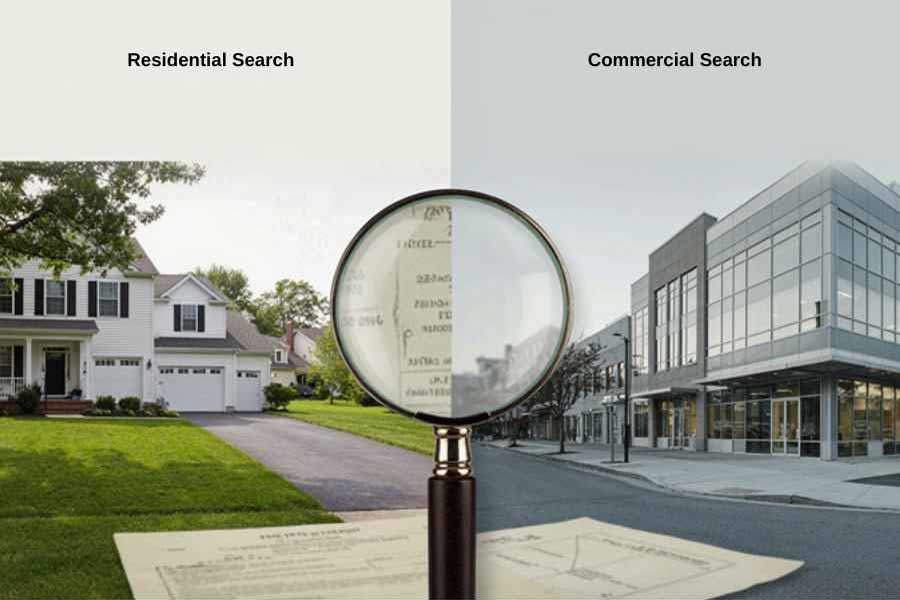
If you’re buying a home in Montclair or acquiring a strip mall in Edison, you might assume a property search is a property search. It isn’t. The paperwork, the risks, and the people who need to sign off all change depending on whether the deal is residential or commercial and in New Jersey, where municipal rules and county recording practices vary block by block, that difference can make or break your closing timeline.
This guide breaks down what separates a residential property search from a commercial one, what each actually covers, and why buyers on either side of that line need to know the distinction before they get anywhere near a closing table. If you’re deep in a commercial deal already, this piece pairs with our cornerstone guide, Commercial Property Search Guide: Essential Due Diligence Before Closing, which walks through the full due diligence checklist step by step.
What Is a Property Search, and Why Does It Matter in New Jersey?
A property search is the process of digging through public records to confirm who actually owns a piece of real estate, what’s owed against it, and whether anything a lien, an easement, a zoning violation could interfere with a clean transfer of title. In New Jersey, that means pulling records from the county clerk or register of deeds, the tax assessor’s office, and often the municipal construction and zoning departments, since New Jersey handles land use approvals at the local level rather than the county level.
Every property search, residential or commercial, exists to answer one question: can this deal close without a nasty surprise attached to the deed? The scope of that question is where the two paths diverge sharply.
Residential Property Searches in New Jersey: What's Involved
Standard Residential Search Components
- Chain of title — confirming ownership history back 30-60 years
- Mortgages, liens, and judgments against the current owner
- Property tax status with the local municipality
- Certificate of Occupancy or resale certificate requirements, which many NJ towns require before a home can legally transfer
- Survey and easement review, particularly for older properties near property lines
Timeline and Cost for Residential Searches
Residential searches in New Jersey typically run one to two weeks and cost several hundred dollars, bundled into standard closing costs. The process is repeatable, title companies run essentially the same checklist on every single-family sale, which keeps it fast and predictable.
Commercial Property Searches: A Different Level of Complexity
Commercial deals, office buildings, retail centers, warehouses, mixed-use developments, carry more risk, more stakeholders, and far more moving pieces. A commercial property search has to answer questions a residential buyer never has to ask.
Additional Due Diligence Items for Commercial Deals
- Zoning and land use compliance since a use variance from decades ago can restrict what the buyer is legally allowed to operate on-site
- Environmental history often triggering a Phase I Environmental Site Assessment given New Jersey's strict contamination disclosure laws under ISRA (the Industrial Site Recovery Act)
- UCC lien searchesagainst business personal property, fixtures, and equipment tied to the site
- Existing lease abstracts and tenant estoppels for income-producing properties
- Municipal and DEP permits, easements for utilities, and any open code violations
- Judgment and litigation searches against every entity in the ownership chain, not just the current seller
Why Commercial Searches Take Longer
Commercial due diligence in New Jersey commonly stretches four to eight weeks, sometimes longer for industrial or environmentally sensitive sites. Multiple parties, lenders, environmental consultants, zoning officials, and sometimes municipal planning boards, all need to weigh in before a deal is ready to close.
Commercial Property Searches: A Different Level of Complexity
Commercial deals, office buildings, retail centers, warehouses, mixed-use developments, carry more risk, more stakeholders, and far more moving pieces. A commercial property search has to answer questions a residential buyer never has to ask.
Additional Due Diligence Items for Commercial Deals
- Zoning and land use compliance since a use variance from decades ago can restrict what the buyer is legally allowed to operate on-site
- Environmental history often triggering a Phase I Environmental Site Assessment given New Jersey's strict contamination disclosure laws under ISRA (the Industrial Site Recovery Act)
- UCC lien searchesagainst business personal property, fixtures, and equipment tied to the site
- Existing lease abstracts and tenant estoppels for income-producing properties
- Municipal and DEP permits, easements for utilities, and any open code violations
- Judgment and litigation searches against every entity in the ownership chain, not just the current seller
Why Commercial Searches Take Longer
Commercial due diligence in New Jersey commonly stretches four to eight weeks, sometimes longer for industrial or environmentally sensitive sites. Multiple parties, lenders, environmental consultants, zoning officials, and sometimes municipal planning boards, all need to weigh in before a deal is ready to close.
Key Differences Between Residential and Commercial Property Searches
| Factor | Residential Search | Commercial Search |
| Typical timeline | 1-2 weeks | 4-8+ weeks |
| Environmental review | Rarely required | Often mandatory (Phase I ESA) |
| Zoning depth | Basic compliance check | Full use and variance analysis |
| Lien scope | Property-level | Property + business/UCC liens |
| Lease review | Not applicable | Estoppels, rent rolls, tenant obligations |
| Regulatory bodies involved | Municipal tax/zoning office | Municipal, county, DEP, sometimes state agencies |
This is the core of the residential vs commercial property search question: residential searches confirm a clean title on a single, well-understood asset type, while commercial searches assess title and operational risk across a much wider set of records.
New Jersey-Specific Considerations for Both Property Types
New Jersey adds a few wrinkles that out-of-state buyers often miss. The state’s Realty Transfer Fee (and the added “mansion tax” on higher-value sales) applies to both residential and commercial deals, but the calculation and exemptions differ. Municipalities also vary widely in what they require before transfer — some demand a smoke detector certificate and CO inspection for residential sales, while commercial parcels may need a Continuing Certificate of Occupancy tied to the specific business use. Because New Jersey doesn’t use a statewide title standard, working with a title company that knows the local county recording offices and municipal quirks is often the difference between a smooth closing and a delayed one.
What is the main difference between a residential and commercial property search?
A residential property search confirms clean title on a single home or small rental, while a commercial property search adds zoning compliance, environmental review, business liens, and lease analysis because commercial deals carry more operational and legal risk.
How long does a commercial property search take in New Jersey?
Commercial due diligence in New Jersey typically takes four to eight weeks, sometimes longer for industrial sites or properties requiring a Phase I Environmental Site Assessment. Residential searches usually take one to two weeks.
Do residential property searches in NJ require an environmental review?
Rarely. Environmental review is uncommon for standard home sales but is often mandatory for commercial properties under New Jersey's Industrial Site Recovery Act (ISRA), especially for sites with prior industrial or commercial use.
What is a Certificate of Occupancy, and do I need one in New Jersey?
A Certificate of Occupancy (CO) confirms a property meets local building and safety codes. Many New Jersey municipalities require a resale CO for residential sales and a Continuing CO for commercial properties, tied to the specific business use.
Why do commercial property searches include UCC lien searches?
Commercial deals often involve business equipment, fixtures, or personal property tied to the site. A UCC lien search checks for claims against those assets separately from the real estate itself, something residential searches don't need to cover.
Does New Jersey's Realty Transfer Fee apply to both residential and commercial sales?
Yes, but the calculation and exemptions differ by property type and sale price. Higher-value sales may also trigger New Jersey's additional "mansion tax," which applies to both residential and commercial transactions above certain thresholds.
How do I know if I need a residential or commercial title search?
If you're buying a home, condo, or small residential rental, a standard residential search is usually enough. If you're purchasing income-producing property, a business location, or a site with prior commercial or industrial use, plan for a full commercial due diligence process.
Which Type of Search Do You Need?
If you’re buying a home, a condo, or a small residential rental, a standard residential title search is almost always sufficient, provided your title company checks the municipal certificate requirements specific to that town. If you’re acquiring income-producing property, a business location, or anything with prior industrial or commercial use, budget for a full commercial due diligence process and start it early, since environmental and zoning reviews are usually the long poles in the timeline.
Understanding the residential vs commercial property search distinction upfront helps you set realistic expectations with your lender, your attorney, and your closing date. For a full breakdown of what commercial due diligence should include before you sign anything, see our complete Commercial Property Search Guide: Essential Due Diligence Before Closing.